
Custom Silver Jewelry: Repeat Orders and Moulds
The second order is where a factory relationship either pays for itself or starts over. A silver design carries an MOQ of 50 pcs per design, the design and the mould stay exclusive to the brand under 100% NDA cover, and the master sample from the first run never has to be made again. That combination is what makes a repeat cheaper than a launch.
Key takeaways
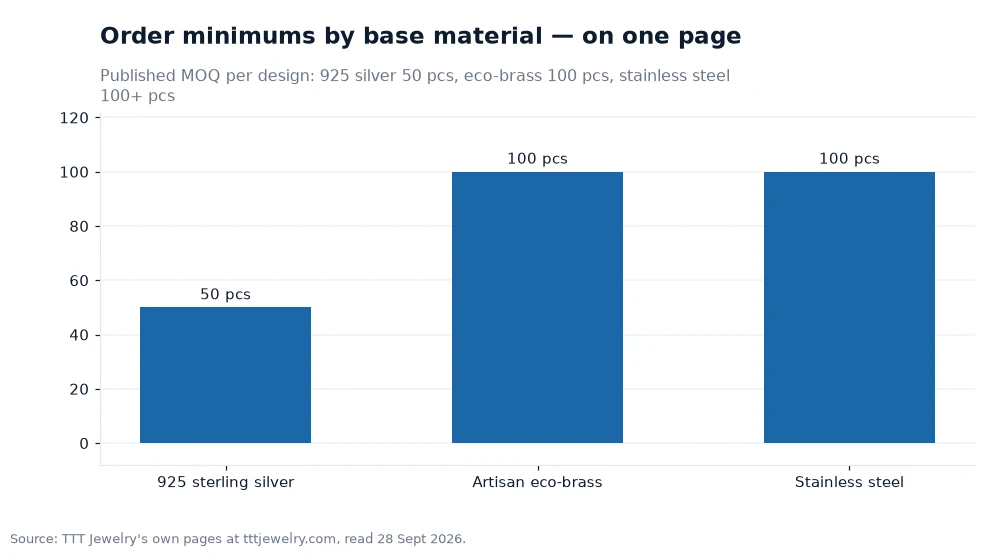
- The floors are 50 in sterling silver, 100+ in the stainless line and 100 in artisan eco-brass, by design, and every further design repeats the figure.
- Moulds and CAD files stay with the order and are not resold or published; agreements are covered by 100% NDA.
- A repeat order re-uses the approved sample and CAD file, so the 25–30 day sampling window is not repeated.
- Mass production runs 3–4 weeks irrespective of whether the design is new, which sets the reorder point.
What actually carries over to a second run
Three artefacts carry over: the CAD drawing, the mould and the approved master sample. With those in hand, the factory is not developing a product again, it is scheduling one. The published workflow starts at bulk production once a sample is approved, and an approved sample from the previous run still does that job.
What does not carry over is the colour check. Plating batches vary slightly, so a repeat order should be compared against the physical sample rather than against a photograph of it. Keep the sample; it is the only reference that does not drift.
Why the minimum stays the same on a reorder
The 50-piece minimum for 925 sterling silver is a tooling and finishing floor, not a one-off development fee. It applies to every order of that design, which is good news for planning: a reorder of, with each extra design adding the same quantity again as the first time.
That is the arithmetic behind a lean inventory policy. A label can hold 50 pieces of a proven seller, sell through, and reorder rather than guessing at 200 pieces of a design nobody has bought yet.
Setting a reorder trigger
Compare the two clocks. Production takes 3–4 weeks after the order is placed, and shipping sits on top. With a 50-piece run and a steady sell-through, the trigger date is roughly the moment half the batch is gone, assuming the design is not seasonal.
Seasonal designs need the trigger earlier, because the production window does not compress for a deadline. If a design sells only in one quarter, the reorder has to be placed while the previous batch is still moving.
Four published details travel with a repeat: each piece stamped with S925, an allergy-free, nickel-free alloy, and a 925 base given eco-friendly electroplating, plus ISO 9001:2015, BSCI and REACH on the compliance page. Sample testing before production belongs to the development of a design rather than to every batch, so a repeat order leans on the approved reference sample and the spec sheet that travelled with it.
Mould ownership in plain terms
The published position is simple: designs stay exclusive to the brand, and moulds, CAD files and collections are not resold or published. For a brand whose whole value is its designs, that is the clause that matters more than any price line.
Put the point in writing anyway, in the purchase order rather than in a conversation. If a supplier will not state ownership of a mould in the order document, the mould is not really yours.
| Material | Minimum per design | Repeat-run note |
|---|---|---|
| 925 sterling silver | 50 pcs | Same floor on a reorder |
| Artisan eco-brass | 100 pcs | Twice the silver floor |
| Stainless steel | 100+ pcs | Highest entry quantity |
| Designs and moulds | Exclusive to the brand | Not resold or published |
Worked example: costing a repeat against a launch
Take a first silver order of, which a second design simply doublessample in front of production. Now take the repeat of the same, so a range of two designs is priced twice overroduction.
In weeks, the launch path is roughly 0.3 + 4.3 + 4 = 8.6 weeks at the slow end, and the repeat path is 4 weeks. The repeat is 4 ÷ 8.6 = 46% of the launch runway, so a reorder placed in the first week of a sell-out still lands about a month before a fresh development cycle would. The windows and minimums are published; the comparison is mine.
Bridge orders between the two
A repeat order of an existing design and a new design can be scheduled in one production block, which is the practical way to keep a shelf stocked while a new piece is developed. The new design consumes the CAD and sampling stages; the repeat goes straight to production.
That pattern also spreads the tooling cost across a single purchase order, since each design still meets its own minimum. If you want the detail on how one order can cover both routes, the short summary of the OEM and ODM difference explains when a design is treated as yours and when it is co-developed.
What changes between runs, and what does not
Four things are fixed by the drawing and the mould: dimensions, metal, stone setting and the hallmark. Nothing in that list is negotiable on a repeat without a new tool, which is why a reorder brief is short — it names the design, the quantity per design and the finish, and stops.
Three things do move between batches. Plating colour shifts slightly from tank to tank; polishing leaves a different micro-finish if the wheel is dressed differently; and packaging can be re-specified on any order. All three are comparison points against the approved sample rather than reasons to redevelop a design. Brands that want the published detail on minimums, coating and plating can learn more on the manufacturer's own silver page, which lists each of them on one sheet.
The fourth variable is timing, and it is the one buyers control. A repeat sits in a queue for 3–4 weeks of production; where it sits in that queue depends on when the purchase order arrives and whether the approved sample is confirmed as the reference.
Frequently asked questions
Do I have to pay for sampling again on a reorder?
No development cycle is needed for an unchanged design. With the approved sample, CAD file and mould already in place, a repeat goes straight to the 3–4 week production block.
Does the minimum change for a second order?
No. Minimum order quantities are 100 pcs in eco-brass, 50 units in the silver line and 100+ pcs in stainless, per design, with each design counted separately.
Who owns the mould after the order is delivered?
The brand does. Designs remain exclusive to your brand, and moulds, CAD files and collections are not resold or published; the published agreements are covered by 100% NDA.
Planning the second order before the first ships
Write the reorder trigger into the launch plan the same week the sample is approved: a stock level, a date, and the name of whoever raises the order. A repeat batch has to match the coating and the plating colour of the first one, and the physical sample is the only reference that settles both questions without a debate.
For ranges that span metal types, keep the brass minimum in mind when a plated version of a proven silver design is added, because the entry quantity doubles even though the artwork barely changes. The eight factory steps are worth re-reading at the same time, since a repeat skips three of them outright.
The source for the claims above — the eco-conscious electroplating; the per-piece inspection rule, the S925 stamping — is the brand's own pages through tttjewelry.com, checked 28 Sept 2026. The sums behind the example are my own construction rather than the manufacturer's[1].