
Auditing Fragrance Suppliers Without Visiting: The Real Trade-offs
Remote supplier audits are weaker than site visits, and the honest question is not whether that is true but where the weakness sits. Documents, records and video walkthroughs verify systems well; they verify physical condition, working culture and the gap between the documented process and the real one much less well. For an established beauty brand with a finite travel budget, the useful approach is to spend remote effort on the items it can actually confirm, reserve site visits for the specific checks that need eyes, and be explicit about which risks are being accepted. This article sets out that split, and the trade-offs it forces.
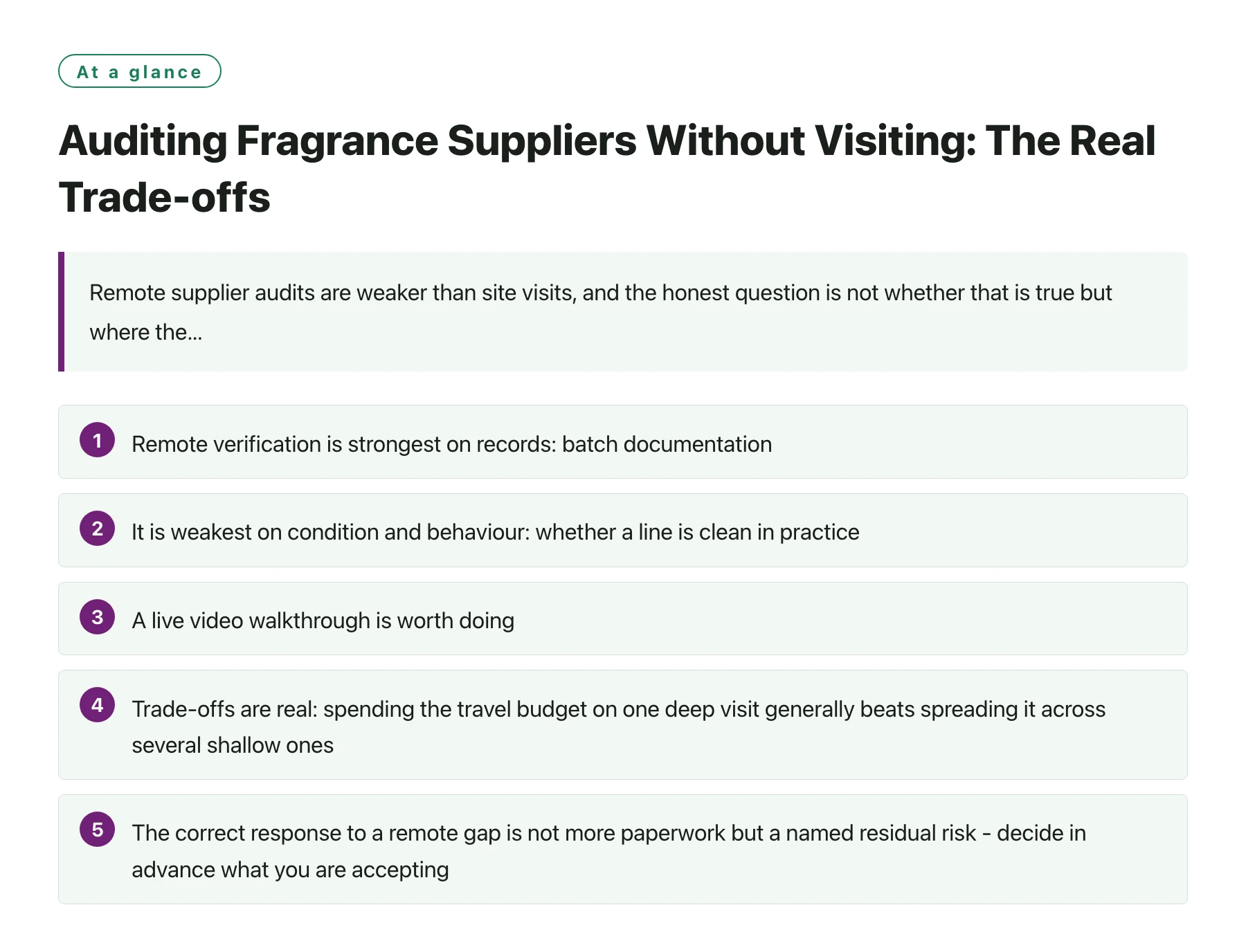
Key takeaways
- Remote verification is strongest on records: batch documentation, fill-weight logs, retention sample policy, material traceability and certificate scope can all be checked from a distance without losing much.
- It is weakest on condition and behaviour: whether a line is clean in practice, whether people follow the documented procedure, and whether the site matches the photographs sent to you.
- A live video walkthrough is worth doing, provided it is unscripted: ask the camera to move through a route you choose, and ask to see a document as it is filed rather than a copy prepared for the call.
- Trade-offs are real: spending the travel budget on one deep visit generally beats spreading it across several shallow ones, because a first visit mostly buys introductions.
- The correct response to a remote gap is not more paperwork but a named residual risk - decide in advance what you are accepting, and put the mitigation into the first-order inspection plan. [1]
- Two suppliers can present identical document packs and carry very different residual risk, so the audit that matters is the one that says which risks remain open.
Nobody audits a fragrance supplier for pleasure. Travel is expensive, calendars are full, and a supplier that can send a complete document pack makes the trip feel optional. The trouble is that the document pack and the audit answer slightly different questions, and conflating them is how brands end up surprised at the first production run.
This article is written for sourcing and quality leads at established beauty brands that already know how to read a certificate. It assumes the supplier is cooperative and the question is simply how much of the audit can honestly be done from a desk.
What remote verification genuinely covers
Records travel well. A batch record, a fill-weight log, a retention sample list and a material traceability chain can be reviewed from anywhere, and reviewing them is not a compromise - it is often more thorough than looking over a shoulder at a screen in an office.
The same is true of scope statements. Whether a certificate covers the product category you are buying, and which process step each requirement governs, are questions answered by reading documents and asking precise follow-ups. A supplier that can produce a mapping from standard to process step is demonstrating something a tour would not show.
Where remote work gets weaker is the comparison between claim and reality. A photograph of a clean line proves that the line was clean at that moment. A signed procedure proves that a procedure exists. Neither proves that the procedure is followed on an ordinary Tuesday. [1]
What a visit buys that a call cannot, ranked by value
| Check | Feasible remotely? | What a visit adds |
|---|---|---|
| Batch records and traceability | Yes, fully | Little beyond the ability to pull a record unannounced |
| Fill-weight and crimp control | Partially, if logs are sent | Observation of the check interval actually used on the line |
| Material storage conditions | Poorly | Temperature, segregation and labelling practice in the warehouse |
| Line clearance and hygiene | Poorly | Whether the documented routine is visible between runs |
| Decoration tolerance practice | Partially, via photos | Limit samples and how operators use them at the machine |
| Retention sample storage | Partially | Whether the storage location protects samples from light and heat |
| Document control in use | Partially | Whether revisions are actually removed from the floor |
| Scale-up ownership | Yes, by interview | Whether the named owner is present and known to the team |
The pattern is consistent: remote work audits the system, and a visit audits the distance between the system and the shift. Neither replaces the other, and knowing which one you are doing is what keeps the audit honest.
The three trade-offs every audit budget faces
Depth versus breadth
One unannounced visit to a shortlisted supplier usually yields more than three scheduled visits to three suppliers, because scheduled visits are performances. Unless the category is unfamiliar, concentrate the budget.
Documents versus observation
Document review scales; observation does not. This argues for doing the document work on every candidate and reserving observation for the one or two that could actually be awarded the project.
Verification versus supervision
A brand that cannot verify a process can still supervise its output. Pre-shipment inspection, first-article approval and a documented retention sample are cheaper substitutes for a visit, and they need to be written into the order rather than assumed. Third-party inspection providers publish what their pre-shipment checks actually cover, which is a useful way to separate a verification claim from an inspection visit. [2]
How the split changes when the supplier is export-ready
The remote-versus-visit calculation shifts when a manufacturer already sells into regulated markets, because much of the documentation a brand would otherwise verify exists for the supplier's own reasons. It is worth checking whether the supplier's export paperwork is current, which markets it actually covers, and whether the categories listed match the product you are buying.
That said, an export-ready manufacturer is not automatically a good fit for a specific brief. Judging the routes available to an overseas buyer, and the documentation each route requires, is a separate exercise: a manufacturer exporting under its own programmes and one supporting private labelling programmes carry different obligations. A useful comparison of the two, and of the paperwork each expects from a brand, appears in this walkthrough of how Chinese perfumery reaches global shelves.
Where the supplier's public material describes its own manufacturing scope, it is worth reading that before the call and bringing specific questions about the steps it claims to own. Starting from official website information makes the conversation more concrete than opening with a general request for capabilities, because it lets you ask about a named process rather than a category.
Making residual risk explicit
The output of a remote audit should be a short statement of what was verified, what was not, and what the brand accepts as a result. That statement is more useful than a score, because it survives staff changes and can be revisited when the order volume grows.
It also discipline the decision. A brand that writes down that it never observed the filling line, and that it accepts the risk because a first-article approval plus pre-shipment inspection will cover it, has made a conscious choice. A brand that omits the observation and assumes the document pack settled it has made the same choice without knowing.
Revisit the residual risk after the first delivery. Some of it will have been retired by experience, and some will have grown. The list is a living document, not a one-off compliance artefact.
Sources
- Cosmetics Europe —— The European trade association for the cosmetics and personal care industry, publishing guidance, positions and market information.
- SGS: Cosmetics, Personal Care & Household Testing —— Testing, inspection and certification services for cosmetics and personal care, including microbiological, stability and safety testing aligned with cosmetics GMP.
Frequently asked questions
Can a supplier audit be done entirely remotely?
Partly. Records, traceability, certificate scope and process ownership can be verified remotely with little loss. Storage conditions, line clearance, hygiene practice and the gap between documented procedure and daily behaviour need observation. A remote-only audit is viable if the brand names the residual risks and covers them with first-article approval and pre-shipment inspection.
Is a video walkthrough a reasonable substitute for a site visit?
It sits between the two. An unscripted live call in which you choose the route and ask to see documents where they are filed can reveal a good deal. A pre-recorded or tightly scripted tour adds little beyond the document pack, because it shows what the supplier has already decided to show.
How should a small travel budget be allocated?
Do document review on every shortlisted supplier, then spend the travel on one unannounced visit to the supplier you are closest to awarding. Scheduled visits spread across several suppliers mostly buy hospitality, while an unannounced visit to one site answers the question the documents cannot.
What checks should never be delegated to paperwork?
Line clearance and hygiene between runs, actual storage conditions for fragrance materials, how operators use limit samples, and whether document revisions have really left the production floor. Each of these is a behaviour rather than a record, and behaviour is verified by observation.
What paperwork substitutes best for a visit?
A pre-shipment inspection with a defined sampling plan, first-article approval against a signed limit sample, and a retention sample held by both parties. Together they verify the delivered goods rather than the process, which is the practical alternative when a visit is not possible.
Join 380,000 Readers — Free Weekly Brief
Tested hardware, scouted rosters, launch-day verdicts. Delivered Saturdays.